Donor Recognition: What’s in a Name?
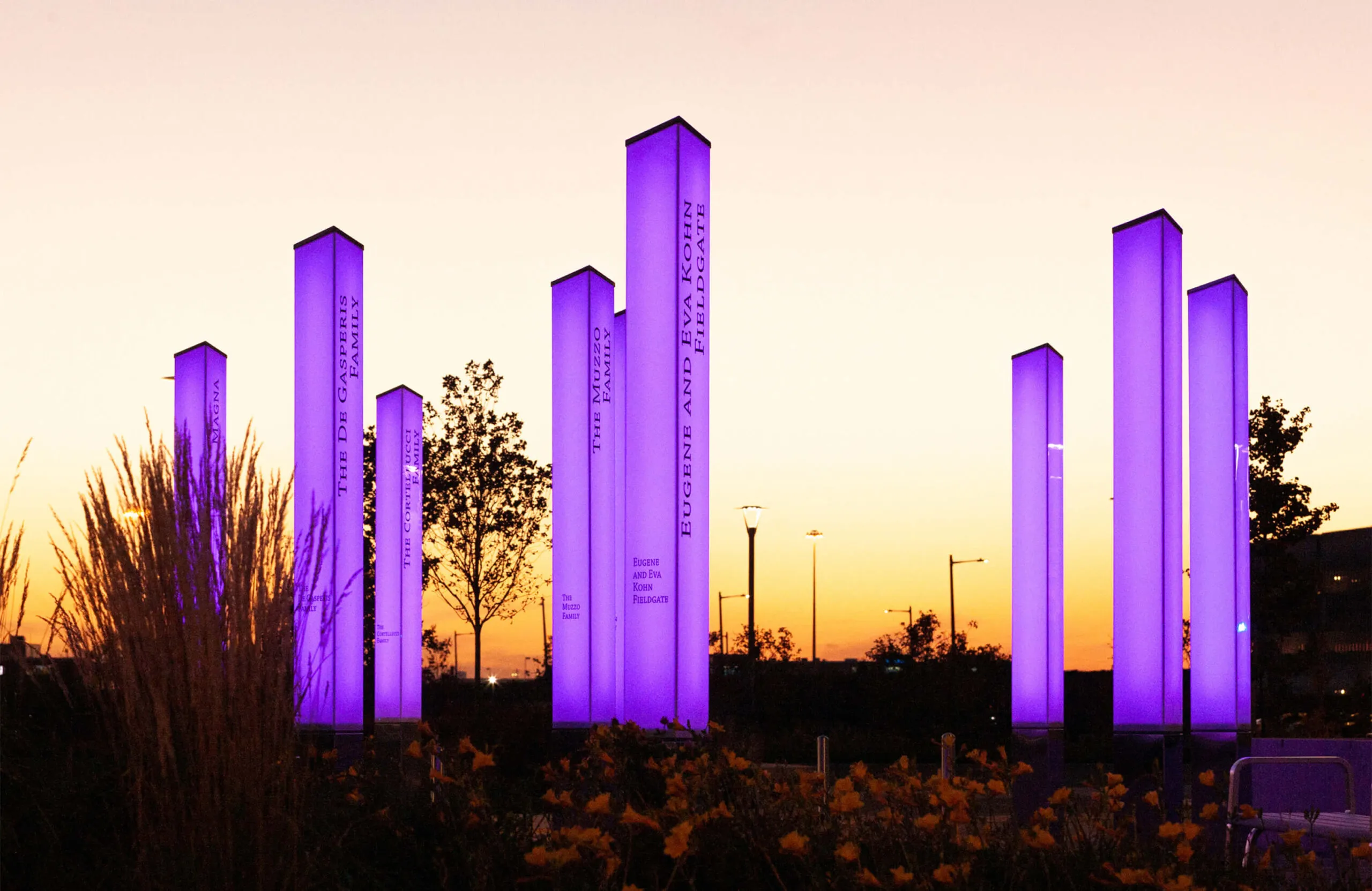
What does the presence of the past tell us about the future?
Danish philosopher Søren Kierkegaard once stated, “Life can only be understood backwards, but it must be lived forwards.” This perspective is particularly thought-provoking because our past and present are deeply intertwined, shaped by memories and our aspirations for the future. It is also a powerful premise for reflecting on how we recognize, honour and remember through donor recognition.
From a curatorial point of view, donor recognition defines history, legacy, lived experience, philanthropy and the very concept of service and achievement, primarily expressed through names on a wall. These names are inscribed, embedded, carved, routed, laser-cut, or pin-mounted on stone railings, pillars, gateways, buildings, park benches and edifices. They stand the test of time and our lifetimes in memoriam, in tribute, in recognition, in honour, or in acknowledgement of contribution or service. They supplement our impermanence with the permanence of what we stood for, believed in, envisaged, and contributed.
Who’s Who in the Donor Recognition Space
Your donor is the hero. This doesn’t take away from the great work your staff is doing.
― Jeremy Reis
Behind the names and faces of gift-giving are special departments and dedicated people who plan and strategize programs and campaigns. Donor Relations & Services handles day-to-day gift processing, responds to inquiries, and publicly acknowledges donations. The Development Department oversees overall fundraising efforts and designs and executes recognition programs. The External Relations, or Advancement, Office oversees major gifts, donor stewardship and other donor interactions. Within this framework, a specialized team focuses on stewardship and donor relations, thanking donors and managing named spaces. The Office of Philanthropy celebrates, tracks, and acknowledges financial contributions from individuals, families, businesses, and community groups. These departments face challenges in honouring donors and contributions, developing communication strategies that define tiers and hierarchies of gift-giving and managing the ever-growing challenge of limited display space.
Donor recognition teams are increasingly exploring creative ways to acknowledge donors beyond traditional methods like names on walls, engraved plaques, or familiar trees with names. This shift suggests that the public’s perception of naming in philanthropy may need reassessment. The focus is moving from static displays to dynamic representations that tell the story behind each name. Consequently, interest is growing in alternatives such as digital interactive storytelling, hybrid solutions that blend physical and digital elements, and public art. These options could add a new dimension to donor recognition and enhance creative placemaking as part of capital planning.
The Winds of Change: How Recognition is Evolving
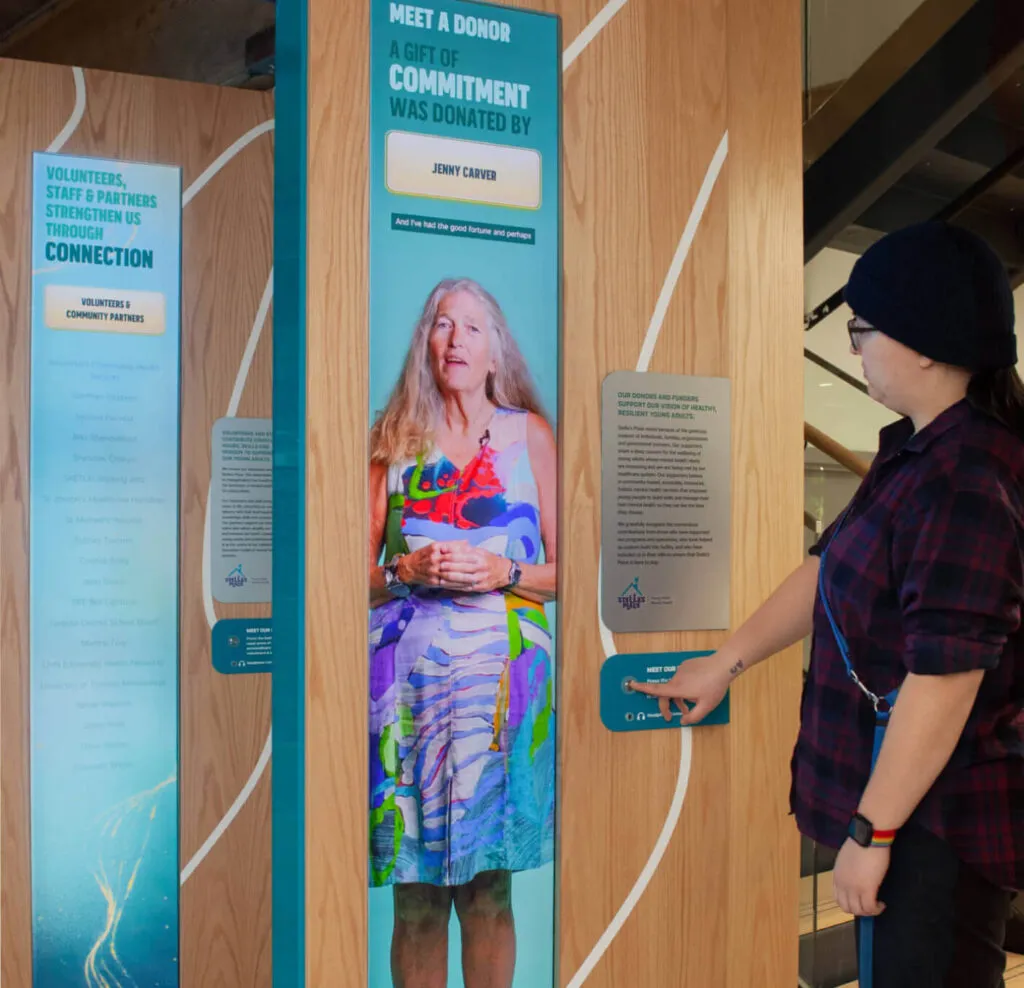
Stella’s Place Donor Hybrid Interactive Recognition, Toronto, Ontario
Growing interest in shifting from physical forms of expression to the digital realm offers flexibility to showcase diverse names and stories. However, digital technology has a drawback: it can face the same issues as static displays, such as becoming outdated or blending into the background. This can lead to ‘inattentional blindness,’ a phenomenon where people fail to notice visible objects right in front of them or where features designed to attract attention are routinely ignored.
This issue is especially relevant in healthcare donor recognition, where there is heightened sensitivity to arrival anxiety and neurodiversity. In such environments, digital media may be distracting, increasing cognitive load and elevating stress levels.
The Psychology of Giving
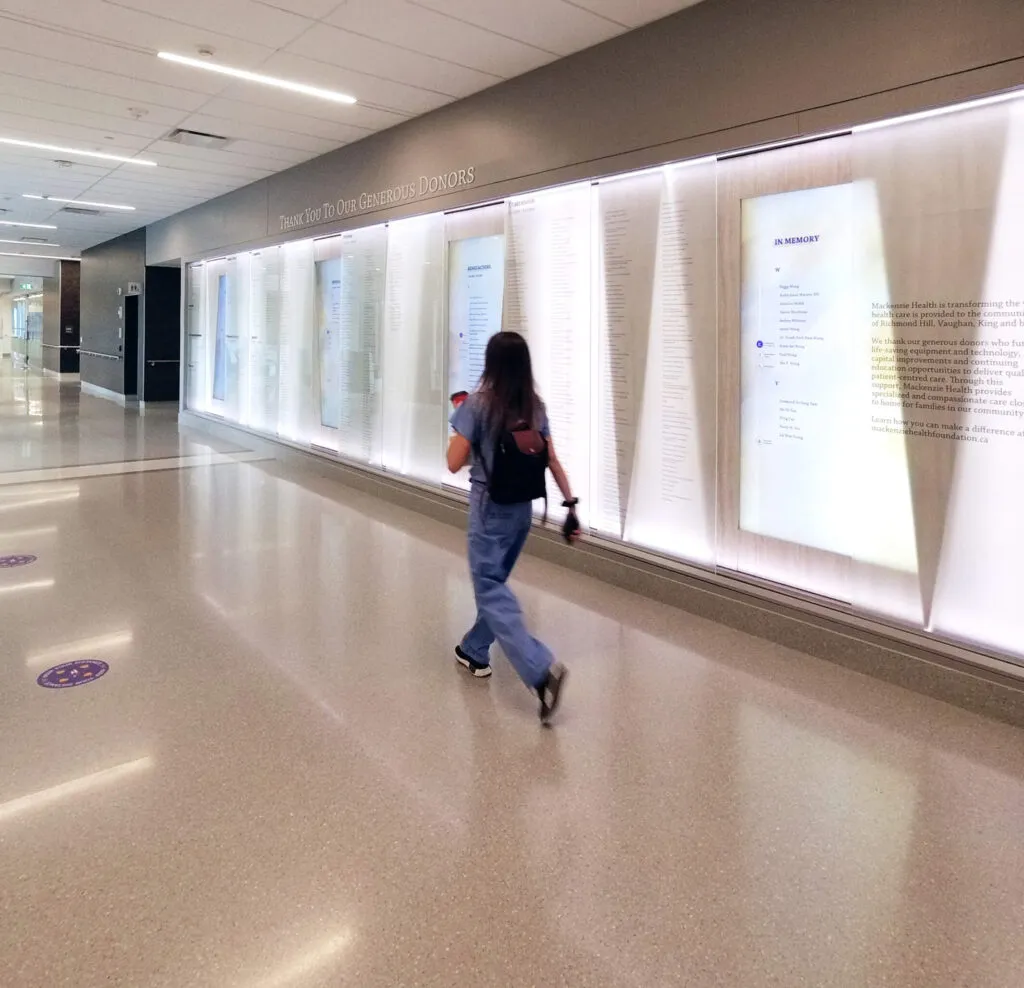
Cortellucci Vaughan Hospital Hybrid Donor Recognition Public Art, Vaughan, Ontario
We make a living by what we get; we make a life by what we give.
— Winston Churchill
Envisioning donor recognition is not a singular endeavour; it is multidisciplinary and multifaceted. It requires strategic planning, foresight management, technical optimization, and, most importantly, alignment of interests. A successful donor recognition program needs a strategic framework that establishes a clear communication hierarchy, thoughtful spatial design, and aesthetic considerations, all aligned with the donors’ mission, vision, values and philanthropic narrative.
Tell me the facts, and I’ll learn.
Tell me the truth, and I’ll believe.
But tell me a story and it will
live in my heart forever.
— Native American Proverb
Providing a compelling reason to give is more psychological than technical, more customized than off-the-shelf, more curatorial than manufactured, more active than passive. Storytelling plays a crucial role in creating an emotional appeal that encourages individuals to contribute to a legacy celebrated through acts of giving. This foundational element is critical for achieving successful outcomes and ensuring a strong return on investment. Neglecting aligned interests, overlooking co-design opportunities between corporate interests and the community, and failing to future-proof technology or programming can lead to unexpected challenges or a disconnect between donor recognition and the community or donor mission, vision and values.
What’s in a name matters, and considerations beyond naming will ensure the legacy, meaning, and memorability of the names within a framework of interpretive communication supports and reflects future philanthropic opportunities for years to come.
The presence of the past tells us everything about our future.