“One’s destination is never a place, but a new way of seeing things.” – Henry Miller
Design is inherently expressive, but it can become insular when offices, studios, and firms rely only on familiar experiences and desk research for inspiration. The working space often becomes a repository where we collect ideas, curate, and then project our experiences within the safety and comfort of our locality and centrality. I describe this as “folding in.” It can lead to sensory detachment from the broader world. As a result, our perceptions become overly influenced by our immediate surroundings, nomenclature and culture. These factors shape our sensibilities and preferences in expressing design ideas. Moreover, we can form contradictory beliefs that subconsciously privilege localized perspectives over others’ indigeneity, history, and cultural anthropology.
I often reflect on what I consider the Achilles’ heel of designers: an ocular-centric preoccupation, obsession and overreliance on the visual, focusing on seeing rather than feeling or experiencing. Juhani Pallasmaa’s book, ‘The Eyes of the Skin: Architecture and the Senses’, captures this idea well. He notes;
“But the world of the eye is causing us to live increasingly in a perpetual present, flattened by speed and simultaneity”.
I believe it is impossible to live outside the things you are designing for if your aim is to capture an authentic experience. Images may speak a thousand words, but journeyed memories last a lifetime and neurologically transform how we sense the world; we should seek the soul or spirit of a place, not just its image.
Don’t get me wrong, I completely understand and appreciate that travel is a pain. In Toronto, the 401 and Gardiner Expressway drives, not to mention the TTC to the office, can be soul-crushing and mentally exhausting, let alone a 14-hour flight to Dubai. Yet travel is still the most effective means of achieving immersion and education in terms of cultural and social understanding, comprising ‘acculturation’—which is the process of learning and adopting the customs, values, and language of a particular local culture; ‘enculturation’—the process of aligning oneself with the requirements and expectations of the surrounding culture; and ‘assimilation’—that being the absorption of local information and culture in order to feel a part.
“Life is an unfoldment, and the further we travel the more truth we can comprehend. To understand the things that are at our door is the best preparation for understanding those that lie beyond.” – Hypatia
The ‘unfoldment’ of personal beliefs, cultural norms, and perceptions, and the relinquishing of the comfort of your own situatedness, is the un-tethering needed to grow. If we are to embrace the beautiful and romantic notion from author Christopher Day that places have a soul, or embrace the notion of Christian Norberg-Schulz that “to dwell is to belong to a given place”, or according to Pallasmaa the skin is our most important receptor that informs our eyes then perhaps we must experience the world first hand or risk the loss of authenticity falling into ‘inauthentic everydayness’ never to truly understand the true meaning of ‘Genius Loci’ (Spirit and Sense of Place).
Travel should be inherent to the design experience, and for us, it’s been a collection of memorable, transformative moments. For brevity, we will share only three memorable moments.
Never underestimate the irresistible charm of Canadian Maple Syrup.
Stüssy Tschudin (Principal + Creative Director, Forge Media + Design) and I spent considerable time deliberating what gift would best represent Canada. We agreed that we would never enter an office empty-handed, and we carry ourselves as emissaries and ambassadors for the country we represent. Therefore, having a token of appreciation that embodied Canada’s cultural values was important to us. After some thought, we concluded that maple syrup was the ideal gift. Little did we know how coveted maple syrup is worldwide.
Before our meetings ended, we handed out small containers of maple syrup to all attendees and were taken aback by the warm responses. The smiles, enthusiasm, and moments of people clutching the small containers to their chests were heartwarming. Even a year later, people still spoke of the gift with fondness, along with the challenge of rationing portions to family and friends as long as possible.
As Canadians, we often take for granted what “Canadiana” means to others. Maple syrup, often called “amber gold,” has an enduring quality that evokes nostalgia and heritage. This connection may stem from the craft of making it and its deep Indigenous roots.
Maple syrup also helped us navigate a ‘sticky’ (couldn’t resist) situation at the airport. Security pulled Stüssy aside for screening, and I initially thought his distinctive yellow Pantone suitcase drew attention. It became serious when armed security personnel began questioning the suitcase’s contents. After he tried to explain it didn’t contain motor oil or anything toxic, I saw Stüssy gesture as if pouring and say the word “pancakes.” The security personnel immediately registered it, responded with huge smiles and laughter, and let him pass.
Flying with Falcons
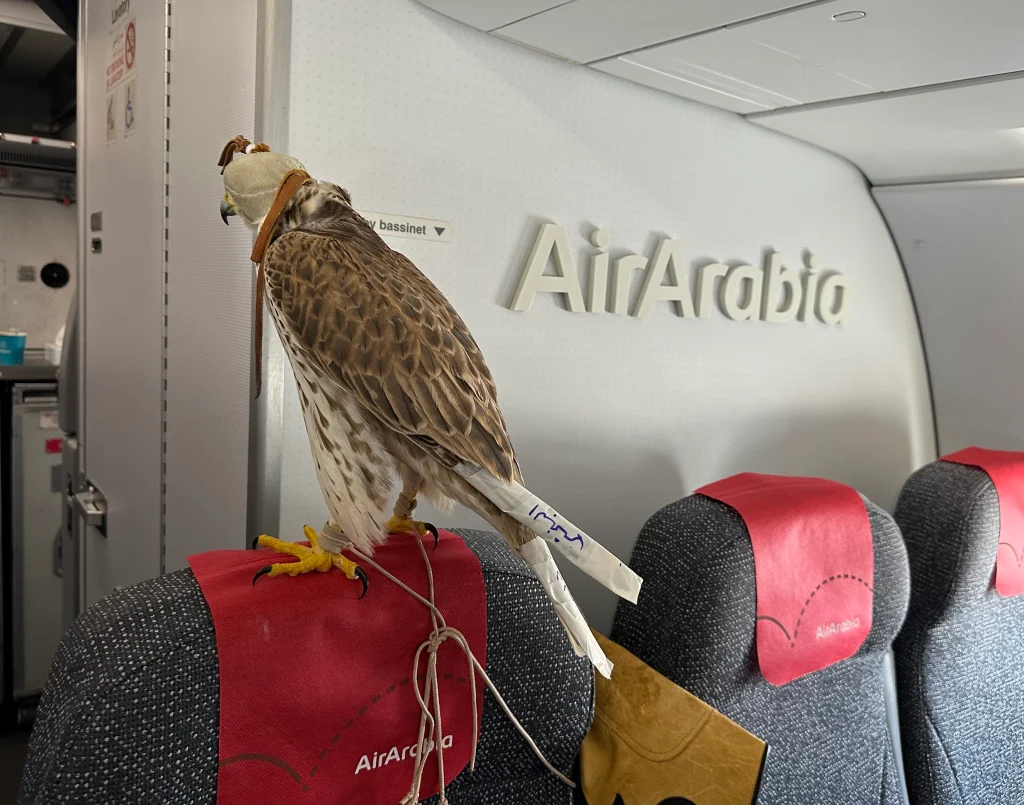
Falcons are already majestic creatures, mythical and highly prized, especially in the Middle East. So, you can imagine boarding a Saudi Air flight, walking down the aisle to your seat, only to find the row behind you occupied by three majestic falcons, neatly perched on a resting bar, complete with falconry hoods and plastic sanitary catch blankets suspended above the seat. The falcons were remarkably docile, but upon takeoff they sensed the gravitational lift of flight, and you can’t restrain a millennium of evolutionary instinct as they tried to flap their wings, settling once the plane reached altitude. Still, they were more behaved than some of the fellow unruly passengers we’ve read about of late.
Without a doubt, it’s one of the more surreal yet privileged sights that we have experienced.
The irreplaceability of being there.
We understood why being there matters. Simply showing up is a sign of respect and shows we are invested in partnership, not just a project, but a personal investment sealed with a warm handshake. This has led to new partnerships, trusted relationships, and a global reputation, all from a small office in Liberty Village, Toronto. It’s why we are often referred to as ‘the little engine that could’.
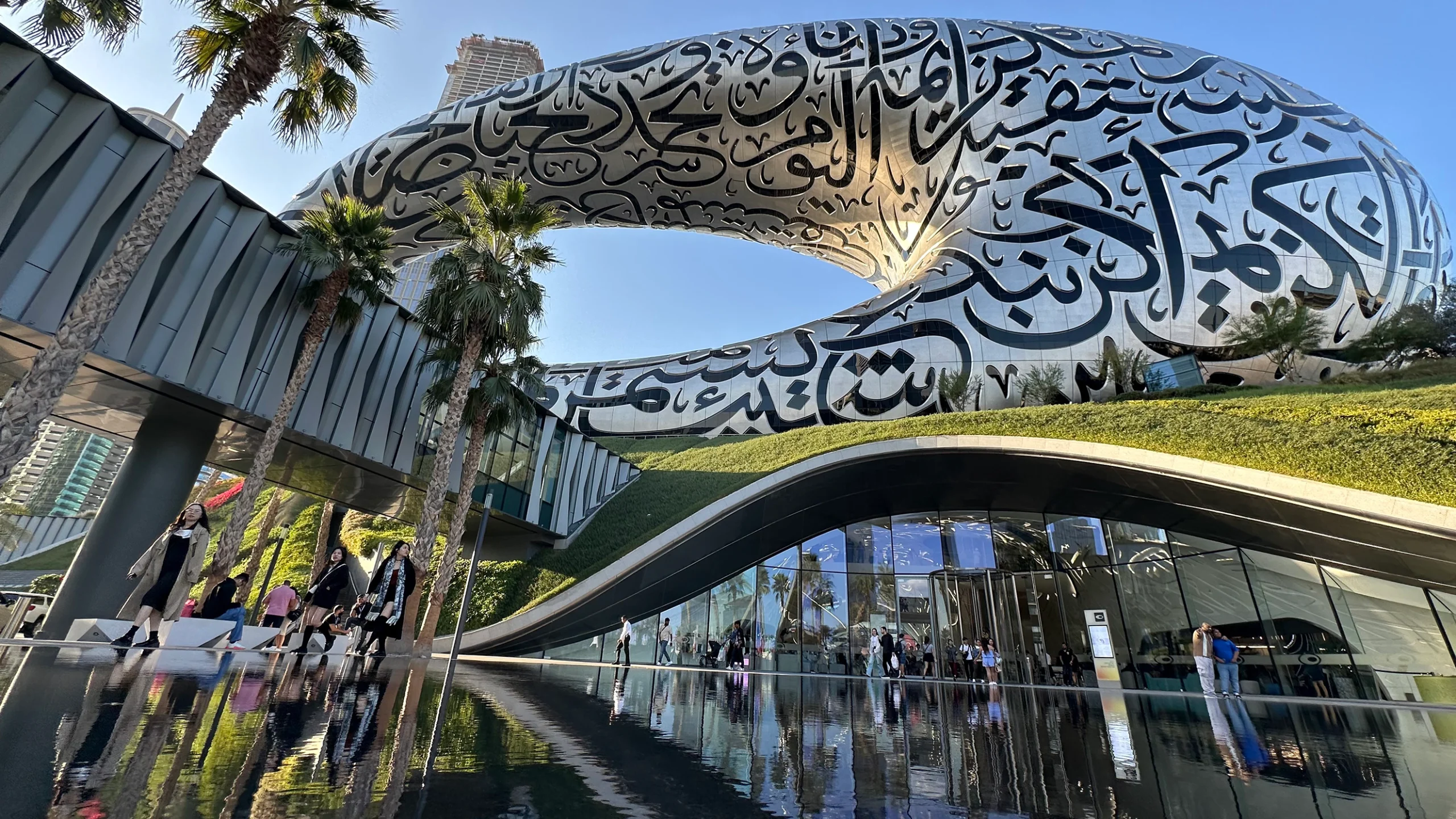
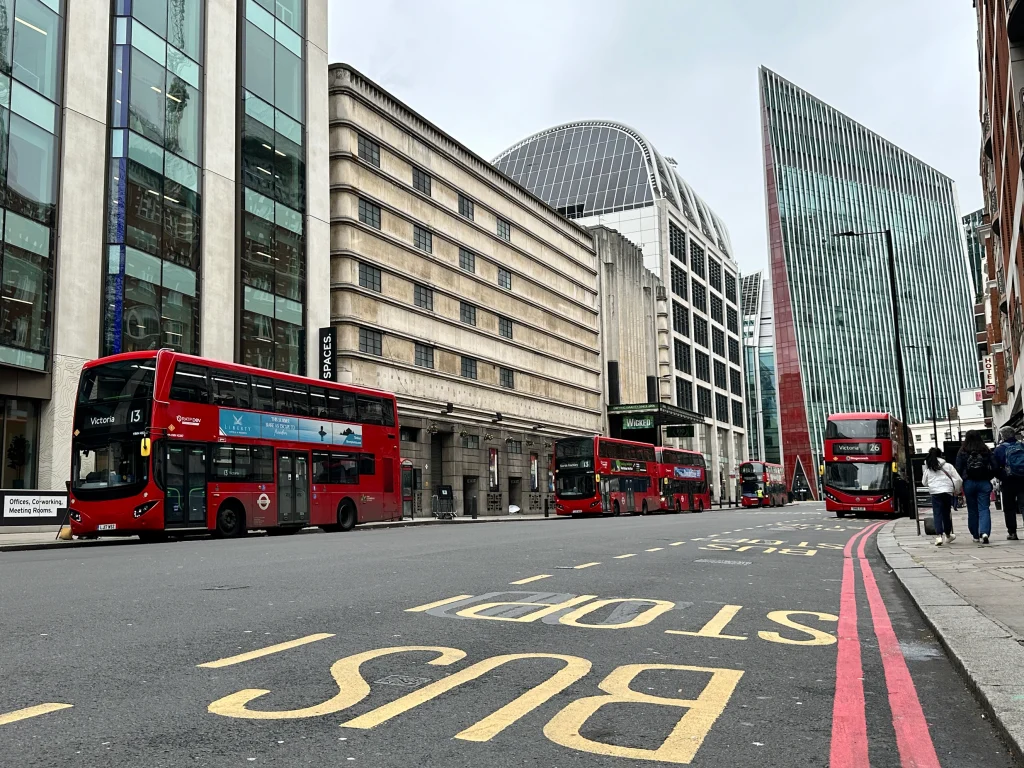
It feels surreal to watch a streetcar travel on tracks through the stress of Musharib, and to pinch yourself to make sure you’re not on King Street in Toronto. Watching the sunset paint the historic Najdi edifice at At-Turaif District, a UNESCO World Heritage Site. Marvelling at architecture in Abu Dhabi’s museum district. Walking over the bridge and canals in the port city of Sharjah. Revelling in the freedom of public expression in the streets of London, immersed in graffiti and street art on the walls of the Leake Street Tunnel. These indelible experiences shape the notion of place and, in turn, the brushstroke of design.
Our three-week itinerary in 2025 looked like this.
By Keith Francis, Senior Associate, Human Factors, Forge Media + Design
Survey
We don’t share our thoughts or opinions just to get likes; we are a curious bunch, so we aim to spark discussion. We hope what we share is relevant and meaningful to you, and if so, we would be thrilled to hear your thoughts. This is how we connect and grow as a community.
What is the most interesting place you have visited?
What difference did it make to your point of view to have visited this place, its inhabitants, and its way of life compared to the research you had done from your desk?
How have the place, the people, or the culture influenced the way you see the world or your design sensibility?
Why Tactile Freehand Expression in a Digital Age Matters
“I dream of my painting and I paint my dream.” – Vincent van Gogh
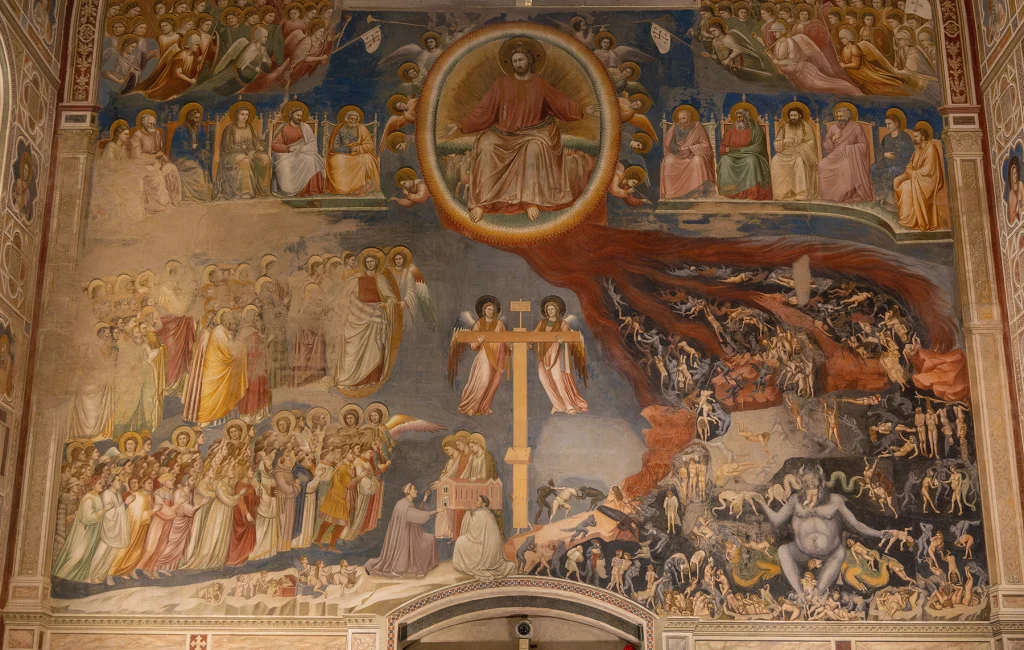
Giotto di Bondone (c. 1267–1337) was an innovative painter and architect from Florence and is usually regarded as the founder of European painting as well as the first great master of the Italian Renaissance. The well-known and unforgettable account of ‘Giotto’s Circle’ has been recorded by many people; it is still worthwhile repeating it simply in order to draw attention to the fact that freehand expression (the act of writing or producing designs by hand without the use of mechanical tools, templates, or digital aids) in the creation of art is dying at the expense of assisted technology and artificial intelligence.
The book, “Lives of the Most Eminent Painters, Sculptors and Architects,” translated from Italian by Mrs. Jonathan Foster, offers a wonderfully illustrative account.
To paraphrase: Pope Benedict IX sent a courier from Treviso to Tuscany to learn about Giotto, as he wanted paintings for St. Peter’s Church. The courier first spoke with artists in Siena before visiting Giotto in Florence. He explained the Pope’s wishes and asked Giotto for a drawing. Giotto politely took a sheet of paper and a pencil dipped in red colour, and without moving his arm or using compasses, drew a perfect circle in one stroke. This moment highlighted Giotto’s superiority over other painters of his time. Proof enough to earn him an invitation to Rome to see the Pope.
“A painter should begin every canvas with a wash of black, because all things in nature are dark except where exposed by the light.” – Leonardo da Vinci
In February 2026, as Canada slumped into the winter doldrums, I was fortunate to be on assignment in Dubai, where the weather was in direct contrast. Stüssy Tschudin (Principal + Creative Director, Forge Media + Design) and I visited a prominent architectural firm in the Dubai Design District. As we sat in the boardroom, two resident architects—expats from Australia and Korea—joined us, British and Swiss Canadians. This diverse gathering exemplified Dubai’s global social environment, a city where over 200 nationalities live and work together. At one point, we began discussing a project’s design details. Like many, we naturally gravitated toward our laptops, checked dongle compatibility, and turned our chairs toward the sole monitor in the room. But before we could connect any devices, one of the architects gestured toward a pencil and paper, choosing to set the technology aside.
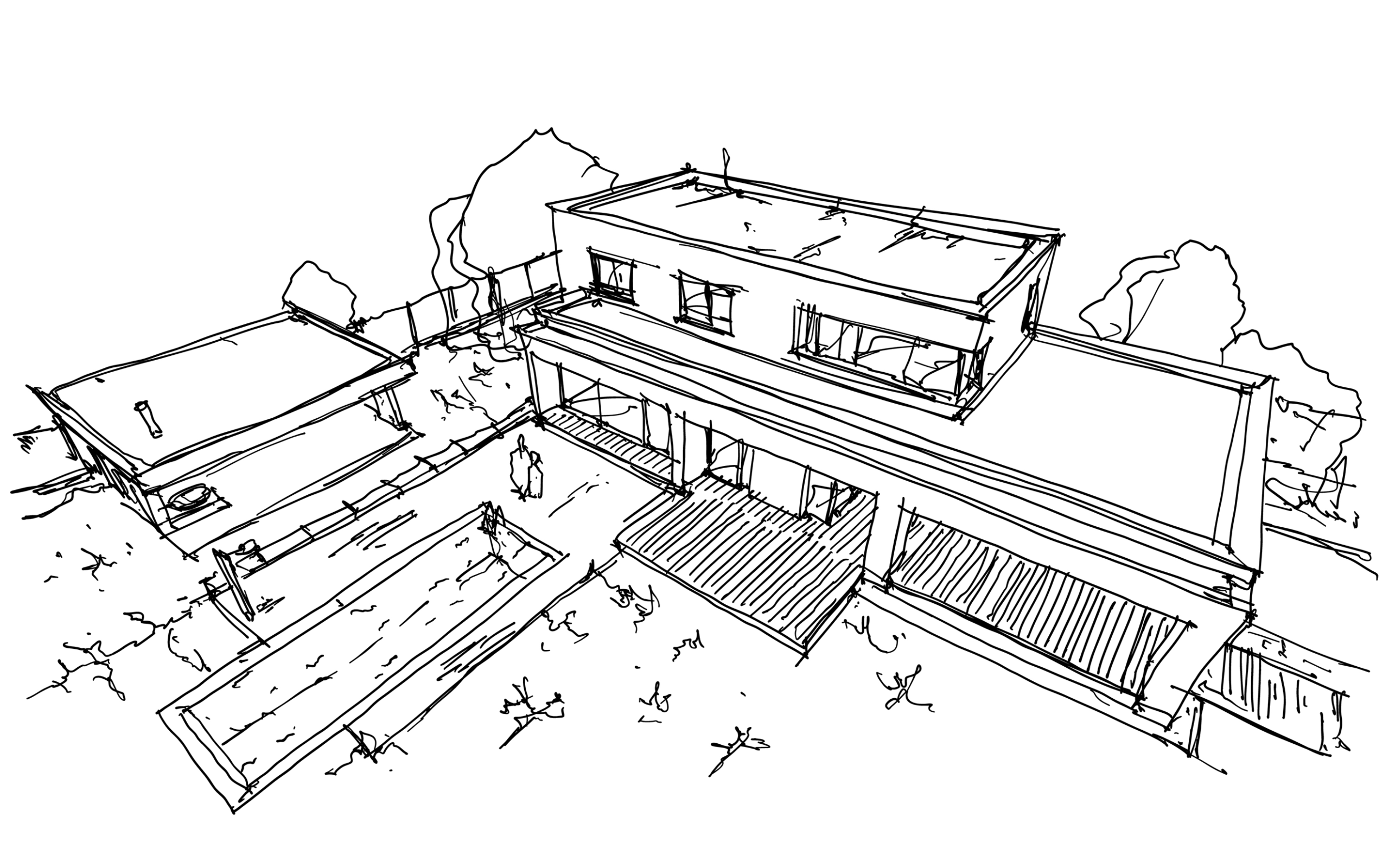
We gathered around the table and what happened next was truly memorable. He began to draw without saying a word, his hands moving across the paper with deft, economical, and purposeful strokes. He created a two-point perspective, starting with a horizon line, as his drafting pencil unfolded the vantage points through precise movements. I watched intently as his eyes guided each stroke, bringing the image to life. The room fell silent as we all focused on him illustrating a building set within a landscape. Though it was drawn in black-and-white pencil, it was perhaps the most colourful transformation I had ever witnessed.
After the long 14-hour flight back to Toronto, this memory remained vivid for many reasons. I kept reflecting on how this architect maintained a sense of craftsmanship in one of the most technologically advanced offices, filled with tools like CAD, Revit, BIM, and Illustrator. Yet he chose to rely on none of them to express himself. His confidence in his natural ability, along with his appreciation for the gradual reveal of his drawing, allowed freehand movement uninhibited by the constraints of a keyboard, screen, or time. His movements clearly stemmed from years of practice, and a hands-on practicum education rooted in craft rather than technology. The intimacy, immediacy and tactile simplicity of that moment outshone the technical utility of software and hardware.
The pencil and computer are, if left to their own devices, equally dumb and only as good as the person driving them.
— Sir Norman Foster
Both Giotto and this modern architect, separated by generations but connected by handcraft, understood the importance of gripping, grasping, welding, and drawing. In other words, appreciation for our unique prehensility (the quality of an appendage adapted for grasping or holding) and our opposable thumbs. These thumbs are anatomically opposed yet can draw a perfect circle or a building’s perspective. That might be why I’m comforted by Sir Norman Foster preferring hand-sketching over computers to conceptualize his buildings, or by Frank Gehry’s, Steven Holl’s or Tadao Ando sketches. There is something marvellously analog that makes you root for the freehand against the algorithm and revel in the realization that human expression of an idea is perfect in its imperfection.
Don’t get me wrong; I celebrate graphic design’s evolution and its pioneers. From John Whitney’s early computer-generated art, Ivan Sutherland’s Sketchpad, Frieder Nake and Georg Nees, Kenneth Knowlton and Leon Harmon, algorithmic patterns and pixel art and A. Michael’s “Gaussian-Quadratic” (1963). The impact of computer art and technology is undeniable. However, the human element should not be seen as an imposition on, or a deficiency in, what freehand can produce.
Giotto’s freehand circle demonstrates artistic mastery, showing that human ingenuity should never be underestimated, undervalued, or discounted in the face of technology, and that we should always be aware of the risk of de-instinctualization involved in that adoption.
In today’s competitive marketplace, first impressions matter more than ever. Whether you’re operating a luxury hotel, managing a municipality, running a healthcare practice or leading an architectural firm, the way your organization presents itself has a direct impact on how it is perceived. High-design is not simply about creating something visually appealing, it is a strategic investment that can significantly influence your brand value and return on investment.
Many organizations mistakenly view design as a finishing touch or cosmetic enhancement. In reality, high-design goes far beyond aesthetics. While a well-designed website, building, publication or digital experience should certainly be functional and user-friendly, true high-design elevates a business into a category associated with quality, credibility and excellence.
Premium brands understand this principle well. They recognize that customers and clients often make judgments long before they engage with a product or service. Design communicates professionalism, attention to detail, and confidence. It tells people what they can expect from an organization before a single conversation takes place.
High-design positions your business in an echelon occupied by industry leaders. It demonstrates that you value quality and are willing to invest in presenting your organization at its best. This perception creates trust, and trust drives decision-making. Whether a potential client is choosing between competing healthcare providers, selecting a hotel, evaluating an architectural firm or considering where to invest public support, perception plays a critical role.
The business benefits of high-design extend far beyond appearance. A thoughtfully designed brand and customer experience can increase engagement, improve conversion rates, strengthen customer loyalty and ultimately generate greater revenue. In this way, design becomes a measurable contributor to ROI rather than an expense.
People often say they buy products or services, but in reality, they buy something much deeper: a perception. Customers choose brands that align with their values, aspirations and expectations. They purchase confidence, trust, prestige, reliability, innovation or comfort. High-design helps establish these perceptions and reinforces them consistently across every touchpoint.
When an organization invests in high-design, it creates a cohesive visual and experiential identity that becomes memorable. It distinguishes itself from competitors who may offer similar products or services but fail to communicate the same level of quality and professionalism. Over time, this differentiation strengthens brand recognition and increases market value.
Ultimately, high-design is about putting your best foot forward. It ensures that every interaction with your audience reflects the caliber of your organization. While functionality remains essential, exceptional design transforms functionality into an experience that resonates with people and leaves a lasting impression.
In a world where perception often influences decisions before facts are considered, high-design is not a luxury, it is a powerful business tool. Organizations that embrace it are not simply investing in how they look, but rather they are investing in how they are perceived, remembered and chosen.